Foundation damage rarely announces itself with a single dramatic event. For most Topeka homeowners, the signs appear gradually, sometimes over months or years, and it can be easy to dismiss them as normal settling or cosmetic issues. But every foundation problem starts small, and the earlier you recognize the warning signs, the less expensive and less invasive the repair will be. Kansas soil conditions, particularly the expansive clay found throughout Shawnee County and northeast Kansas, put constant stress on residential foundations. Here are the seven most common signs that your Topeka home may need professional foundation repair.
Cracks in Walls and Ceilings
Interior wall and ceiling cracks are often the first sign Topeka homeowners notice when their foundation begins to move. Not all cracks indicate a structural problem, but certain patterns are strong indicators that something is happening beneath the house. Diagonal cracks that originate from the corners of door frames and window frames are among the most reliable signs of foundation settling. These cracks form because the wall framing shifts as the foundation moves unevenly, concentrating stress at the corners of openings where the structure is weakest.
Stair-step cracks in brick or block walls, whether in the basement or on the exterior, are another hallmark of foundation movement. These cracks follow the mortar joints in a stepping pattern and typically indicate that one section of the foundation has settled more than an adjacent section. In Topeka, stair-step cracks are extremely common in block basement walls and in the exterior brick veneer of homes built from the 1940s through the 1970s. The seasonal expansion and contraction of Kansas clay creates differential movement that these older masonry materials simply cannot absorb.
Horizontal cracks in basement walls deserve immediate attention. A horizontal crack, particularly one that runs along the middle third of the wall, indicates that lateral soil pressure is pushing the wall inward. This is a structural issue that will worsen over time, especially during Topeka's wet spring months when saturated clay exerts maximum pressure against the foundation. If you see a horizontal crack accompanied by any visible inward bowing of the wall, that is a sign that the wall has already begun to fail and professional evaluation is urgent.
Ceiling cracks can also point to foundation issues, though they are sometimes harder to interpret. Long cracks that run across the ceiling, particularly those that align with cracks in the walls below, suggest that the entire structure is shifting in response to foundation movement. Cracks that appear at the junction between the ceiling and an interior wall, especially if they run the full length of the room, are another indicator. In Topeka homes with plaster walls and ceilings, these cracks tend to be more noticeable because plaster is less flexible than modern drywall.
Sticking Doors and Windows
Doors and windows that suddenly become difficult to open, close, or latch are a classic symptom of foundation movement. When the foundation settles unevenly, the door and window frames shift out of square. A door that used to swing freely may start dragging on the floor or refusing to latch. A window that opened easily may suddenly bind in its frame or develop a visible gap on one side while being tight on the other. These are not signs of humidity or age. They are signs that the structure around the opening has physically moved.
In Topeka, homeowners often notice these issues seasonally at first. During wet spring months, the clay soil expands and pushes against the foundation, and doors may stick. During dry summer and fall months, the clay contracts, the foundation shifts slightly in a different direction, and the doors may work fine again. This seasonal pattern often causes homeowners to dismiss the problem or attribute it to normal house behavior. But this cycle of expansion and contraction is actually the mechanism that is progressively damaging the foundation. Each cycle causes a little more movement, and over time the cumulative effect becomes permanent.
Pay particular attention to interior doors on the first floor. These are often the most sensitive indicators of foundation movement because they are closest to the affected structure. If multiple doors in your Topeka home are sticking or you notice that a door that used to close flush now has a visible gap at the top or bottom of the frame, that pattern suggests widespread foundation movement rather than a localized issue. Double-check by looking at the door frames themselves. If you can see that the frame is no longer square, with gaps at the corners or visible separation from the wall, the foundation beneath that section of the home has moved.
Garage doors can also be affected. If your garage door no longer sits flush on the concrete floor when closed, or if you can see daylight along the bottom edge on one side but not the other, the garage slab or the foundation wall supporting the header has likely settled. This is common in Topeka homes where the attached garage was built on a separate slab from the main foundation, and the two structures settle at different rates on the expansive clay soil.
Uneven or Sloping Floors
Sloping or uneven floors are one of the most definitive signs of foundation settlement. When a foundation settles unevenly, the floor system above it follows, creating noticeable slopes that you can feel when walking through the house. Some homeowners first notice this when a ball placed on the floor rolls consistently in one direction, or when furniture seems to lean or rock on a surface that used to be level. In severe cases, you can see the slope visually by standing at one end of a room and looking across the floor surface.
In Topeka, uneven floors are particularly common in homes where one section of the foundation sits on different soil than another. A common scenario is a home where the original structure was built on well-compacted soil, but an addition was built later on fill dirt that was not properly compacted. Over time, the fill settles more than the native soil, and the floor in the addition drops relative to the original house. This creates a noticeable transition point that may also be accompanied by cracks in the walls near where the two structures meet.
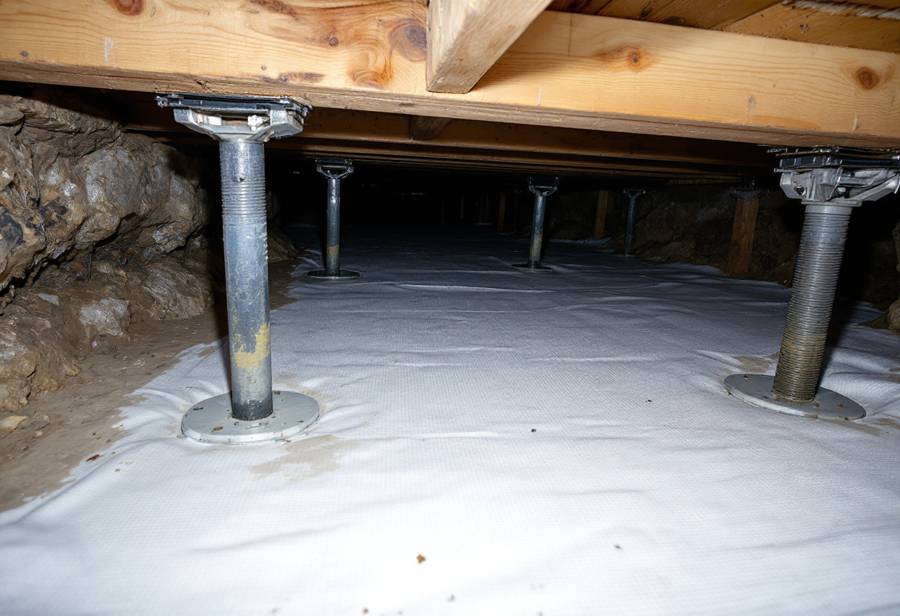
Sagging floors in the center of a room, as opposed to sloping toward one wall, may indicate a different but related issue. If the floor bounces or feels soft when you walk on it, the problem may be deteriorating support beams or columns in the basement or crawl space rather than the perimeter foundation. In Topeka homes with crawl spaces, wooden support posts can rot from moisture exposure, and the adjustable steel columns found in many basements can settle into the concrete floor if the slab was not poured thick enough. Both of these conditions are repairable and are often addressed as part of a comprehensive foundation repair project.
If you suspect your floors are uneven, you can do a simple check with a four-foot level. Place it on the floor in several locations and note where you see gaps beneath the level. A slope of more than one inch over a span of fifteen to twenty feet is generally considered significant enough to warrant professional evaluation. In many Topeka homes we inspect, we find floor slopes of two to four inches across the width of the house, which indicates substantial foundation settling that has been developing over many years.
Gaps Between Walls and Ceiling
Gaps forming between the wall and ceiling are a clear sign that the structural components of your home are pulling apart, and foundation movement is the most common cause. As the foundation settles or shifts, the walls move with it, but the ceiling framing may be anchored differently and does not follow the same path. The result is a visible gap, sometimes narrow enough to be mistaken for a shadow, sometimes wide enough to fit a finger into, running along the junction where the wall meets the ceiling.
In Topeka homes, these gaps often appear first on the side of the house that has experienced the most settling. If the north side of your foundation has dropped while the south side remains relatively stable, you may see gaps along the ceiling on the north-facing walls. The gaps may start small and grow over time as the foundation continues to move. Crown molding can mask these gaps initially, but eventually the molding itself will separate from the wall or ceiling, revealing the underlying movement.
Similar gaps can appear between the wall and the floor, between the wall and door or window trim, or between the chimney and the adjacent wall. Each of these separations tells a story about how the foundation is moving. Gaps around the chimney are especially common in Topeka because many chimneys have their own footings that settle at different rates than the main foundation. If your chimney is pulling away from the house and you can see daylight through the gap, that is both a foundation issue and a potential water intrusion point that needs to be addressed.
Exterior gaps are equally important to watch for. Walk the perimeter of your Topeka home and look for gaps where the siding meets the foundation, where the deck or porch attaches to the house, and where any addition connects to the original structure. These gaps often catch debris, hold moisture, and allow insects and air infiltration. More importantly, they are visible evidence that parts of the structure have moved relative to each other, and the root cause is almost always foundation settlement that will continue to worsen until it is repaired.
Visible Foundation Cracks
Cracks in the foundation itself are the most direct evidence that your foundation has been compromised. While small hairline cracks in concrete are normal and result from the curing process, cracks that are wider than a quarter inch, cracks that grow over time, and cracks that show displacement where one side is higher or further out than the other are all signs of active foundation movement that requires professional evaluation.
Vertical cracks in poured concrete foundations are the most common type and are often the least structurally concerning. These typically result from concrete shrinkage during curing and normal settling. However, even vertical cracks can be a problem if they allow water into the basement, and in Topeka's wet climate, even a hairline crack can channel significant water during heavy rain events. Vertical cracks that are wider at the top than the bottom suggest the foundation is settling more on one side of the crack, which is a structural concern.
Horizontal cracks, as mentioned earlier, indicate lateral pressure and are always a structural concern. In Topeka, these are most common in block foundations where the mortar joints create natural weak points, and in poured concrete walls that were not adequately reinforced with steel. The freeze-thaw cycle in Kansas winters can accelerate horizontal cracking because water that has seeped into the soil freezes and expands, pushing even harder against the wall. A horizontal crack that shows any measurable inward displacement means the wall is actively failing and repair should not be delayed.
Stair-step cracks in exterior brick or block follow the mortar joints in a diagonal pattern and indicate differential settlement. If you trace the crack, it usually leads from a corner or opening in the foundation toward the area of greatest settlement. In Topeka, stair-step cracks are often found on the side of the house where downspout drainage is inadequate and water has been saturating the soil against the foundation for years. The wet side settles more than the dry side, and the differential movement creates the characteristic stair-step pattern. Addressing the drainage issue is an important part of the repair, but the foundation itself also needs structural attention.
Water in the Basement
Water intrusion in the basement is both a symptom of foundation problems and a cause of further damage. When the foundation cracks, shifts, or settles, it creates pathways for water to enter the basement. At the same time, water that pools against the foundation saturates the surrounding soil, increases hydrostatic pressure, and accelerates the very foundation movement that created the entry points. This feedback loop is why water in the basement should never be ignored, even if it seems minor or seasonal.
Topeka receives an average of about 37 inches of rainfall per year, with the heaviest precipitation concentrated in the spring and early summer months. When several inches of rain fall over a few days, the clay soil surrounding your foundation becomes fully saturated and exerts enormous pressure against the basement walls. Homeowners in low-lying areas of Topeka or near the Kansas River may also deal with a seasonally high water table that adds upward hydrostatic pressure against the basement floor slab. These conditions create the perfect environment for water intrusion through any crack, joint, or gap in the foundation.
Signs of basement water problems include visible water on the floor after rain, white mineral deposits on the walls known as efflorescence, damp or musty odors, peeling paint or discoloration on basement walls, and mold growth on walls, floors, or stored items. Even if you do not see standing water, a persistently damp basement in Topeka indicates that moisture is migrating through the foundation, and that means there are pathways in the concrete or block that should not be there.
The connection between water intrusion and structural foundation damage is direct and well understood. Water entering through a foundation crack erodes the surrounding concrete over time, making the crack wider. Water that saturates the soil beneath the footing can cause the soil to lose bearing capacity, allowing the foundation to settle further. And water that freezes in cracks during Topeka's winters expands and fractures the concrete. The repair solution often involves both waterproofing to stop the water and structural repair to address the foundation movement that let the water in. Addressing only one without the other leaves your home vulnerable.
When to Call a Professional
If you have identified one or more of the signs described above in your Topeka home, the next step is a professional foundation inspection. The key word is professional. Foundation assessment requires specific training, experience, and equipment that goes beyond what a general home inspector or handyman can provide. A qualified foundation repair specialist will use laser levels to map floor elevation across your entire home, measure and document all cracks, evaluate wall plumbness, assess soil conditions, inspect drainage, and determine whether the movement is active or has stabilized.
Timing matters. Foundation problems in Topeka never resolve on their own and they never stop getting worse. The expansive clay soil that caused the problem is still there, the weather cycles that drive the expansion and contraction continue year after year, and each cycle pushes the foundation a little further from where it started. A crack that costs $800 to repair today could turn into a $5,000 pier installation job in two or three years if the underlying movement continues unchecked. The most expensive foundation repairs we see in Topeka are almost always in homes where the homeowner knew there was a problem but waited years before addressing it.
You should call a professional immediately if you observe any of the following: horizontal cracks in basement walls with visible inward bowing, gaps wider than half an inch between walls and ceiling or floor, floors that slope noticeably across a room, multiple doors and windows that no longer operate properly, or water actively entering the basement through foundation cracks. These are signs of significant active movement that will cause progressively more damage and higher repair costs the longer you wait.
At Flint Hills Foundation, we offer free, no-obligation foundation inspections throughout Topeka and northeast Kansas. Our inspections are thorough, typically taking 45 minutes to an hour, and include a detailed written report with our findings and recommendations. We are licensed and insured with over 10 years of experience repairing foundations in Shawnee County and the surrounding area. There is no cost and no pressure. If your foundation is fine, we will tell you so. If it needs attention, we will explain exactly what is happening and what it will take to fix it permanently. Call (785) 706-4425 to schedule your inspection today.