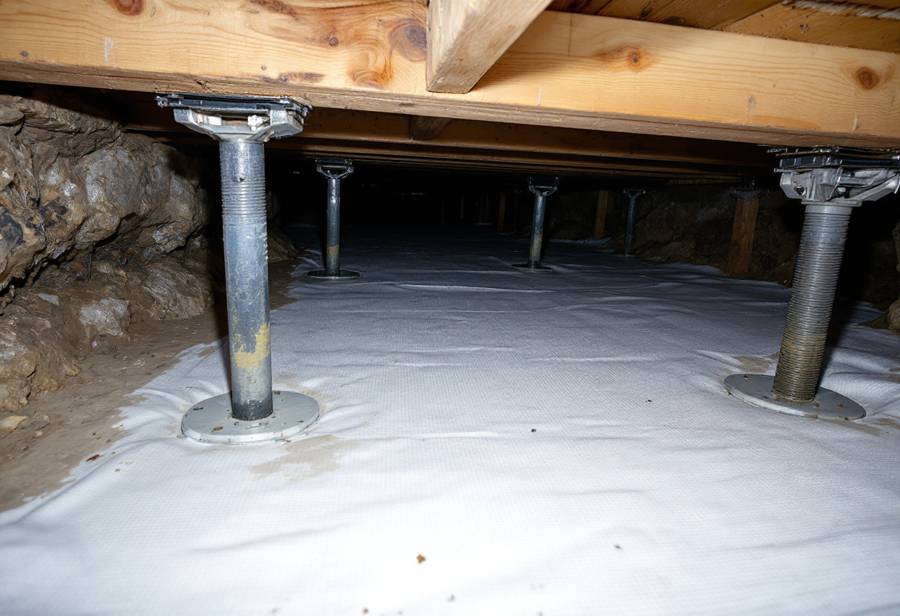
If a Topeka foundation inspector has recommended push piers, you are probably holding a proposal that reads like a foreign language. Pier counts, load ratings, installation depths, warranties, and line items that range from about $1,800 to more than $3,500 per pier. You want to know two things: is this price reasonable, and what is actually going to happen to my house on install day? This guide answers both questions in plain terms, and explains why in most of Shawnee County, push piers are the right structural choice over helical piers.
The Problem: Your Foundation Has Already Moved
By the time a Topeka homeowner is seriously comparing pier quotes, the foundation has usually been moving for years. Expansive clay soil across northeast Kansas swells when wet and shrinks when dry, and that cycle gradually pushes portions of your footing past the point where they can support the weight above. You notice it as cracked drywall, doors that will not latch in October, a floor that slopes an inch and a half across the living room, or a corner of the house that has visibly dropped. Cosmetic repairs hide these symptoms. They do not fix them, because the footing is still failing underneath.
The only permanent fix is to transfer the weight of the settled section of the house off the failing soil and onto competent load-bearing strata deeper in the ground. Piers are how that transfer happens. Push piers and helical piers are the two most common systems. Choosing between them is not a matter of taste — it is an engineering decision driven by soil conditions, building weight, and the type of movement you are correcting.
Agitate: Why the Wrong Pier System Wastes Money
Helical piers are screw-in steel shafts with helix plates that cut into soil and generate load capacity as they advance. They are excellent for lightweight new construction and for pier-and-beam houses on firm soils. In Topeka, where we are most often stabilizing a full-weight two-story home on expansive clay with variable bearing conditions below, helical piers frequently under-perform. The reason is that a helical pier in clay tends to generate torque readings that look good at install time but do not correlate reliably with long-term load capacity once the clay begins a new wet-dry cycle.
Push piers work differently. They are hydraulically driven steel pipe sections that advance straight down using the weight of your house as the reaction force. They only stop advancing when they hit a stratum strong enough to resist that weight. That load test is done in real time, against the actual dead load of your structure, every single pier, every single time. In Topeka's soil profile, that is a substantially more reliable way to confirm that a pier has reached something that will hold. We see long-term outcomes on push piers in Shawnee County that we simply do not see as consistently with helicals on similar homes.
Solve: Push Pier Cost in Topeka (2026)
Expect the following price ranges for professional push pier installation in the Topeka market today. These are all-in numbers that include engineering, excavation, pier hardware, hydraulic drive, load testing, lift attempt, backfill, and a transferable warranty:
- Basic push pier (standard load, 6–8 ft excavation): $1,800–$2,400 per pier. Typical for ranch-style Topeka homes with accessible perimeter and moderate settlement.
- Mid-range push pier (heavier load or deeper drive, 10–15 ft): $2,400–$3,000 per pier. Common for two-story homes, brick-veneered homes, and settlement correction below basement wall footings.
- Deep or structurally complex push pier (15–30 ft drive, tight access, interior pier through slab): $3,000–$3,500+ per pier. Used when clay is unusually deep before hitting competent strata, or when access requires equipment staging.
Total project cost is driven by pier count, which is driven by engineering, not by preference. A typical settling corner on a Topeka home might require 3–5 piers. A full perimeter stabilization on a two-story home with widespread movement can require 10–20 piers. Multiply the per-pier cost by the required count and you get a realistic project budget. Be skeptical of quotes that vary wildly on pier count between contractors — that is usually a sign that one of them is guessing rather than doing the load analysis.
What Install Day Actually Looks Like
A 5-pier push pier install on a Topeka home typically takes one to two working days. Here is what happens from the time the crew arrives until the last pier is set.
Morning 1: Excavation. The crew digs access pits at each pier location along the exterior of the foundation, typically 3 feet wide by 4 feet deep, exposing the footing. This is hand and mini-excavator work and it is messier than homeowners expect. Expect piles of Topeka clay on tarps in your yard. The crew works around landscaping when possible and reinstalls what has to be disturbed, but flower beds along the foundation are going to be affected.
Midday: Bracket attachment. Steel foundation brackets are bolted to the exposed footing. These are the load transfer points that connect your house to the pier system. The quality of this connection matters more than most homeowners realize — it is the single component that carries the entire load once the pier is driven. Proper brackets are rated for your specific load and match the footing geometry of your foundation.
Afternoon 1 and Morning 2: Pier drive. Hydraulic rams mounted to each bracket drive sections of steel pipe down through the soil using your foundation as the reaction mass. The crew adds pipe sections as the pier advances and monitors pressure gauges continuously. Every pier stops at a pressure that corresponds to a verified load capacity — typically 1.5 to 2 times the actual load your foundation will place on that point. This live load test is the key engineering advantage of push piers.
Final step: Load transfer and optional lift. Once all piers are driven, the crew uses synchronized hydraulics to shift the weight of the house from the failed soil onto the pier system. In many Topeka jobs, we also attempt a controlled lift to recover some of the lost elevation and close cracks. How much lift is possible depends on how rigid the structure is and whether the interior finishes will tolerate the movement without additional damage. We talk through lift expectations with you before any jacking happens.
At the end of the project, access pits are backfilled, the site is cleaned, and you receive a written report showing load pressures achieved at each pier. See our pier installation service page for more detail on the systems we use, or our foundation repair overview for how piers fit into a full repair plan.
When Push Piers Are the Right Call (and When They Are Not)
Push piers are the right solution for most foundation settling situations we diagnose in Topeka, Lawrence, and surrounding communities. They are an especially strong fit for full-weight residential structures on expansive clay where load-based verification matters. If a contractor is pushing helical piers on your full-weight home without walking through why helicals are appropriate for your specific soil and load profile, get a second opinion. The right answer depends on the engineering, not on what that company prefers to sell.
Push piers are less appropriate for very lightweight structures — detached garages on thin slabs, decks, porches, and some additions — where there is not enough dead load to drive the pier to refusal. In those cases, helical piers are often the correct answer, and a legitimate foundation contractor will tell you that directly.
Get a Real Engineering Quote
Pier pricing is only meaningful once you have a real pier count, and a real pier count requires a proper inspection. At Flint Hills Foundation, inspections are free, take 45 minutes to an hour, and end with a written recommendation including pier count, installation depths, lift expectations, and the total project price with no add-on line items on install day. We have installed thousands of piers across Shawnee, Douglas, and Riley counties over the last decade. Call (785) 706-4425 to schedule your inspection, or request one through our contact page.